Curious Kids: does music affect how plants grow?
Published September 25, 2026 · CLASSICAL
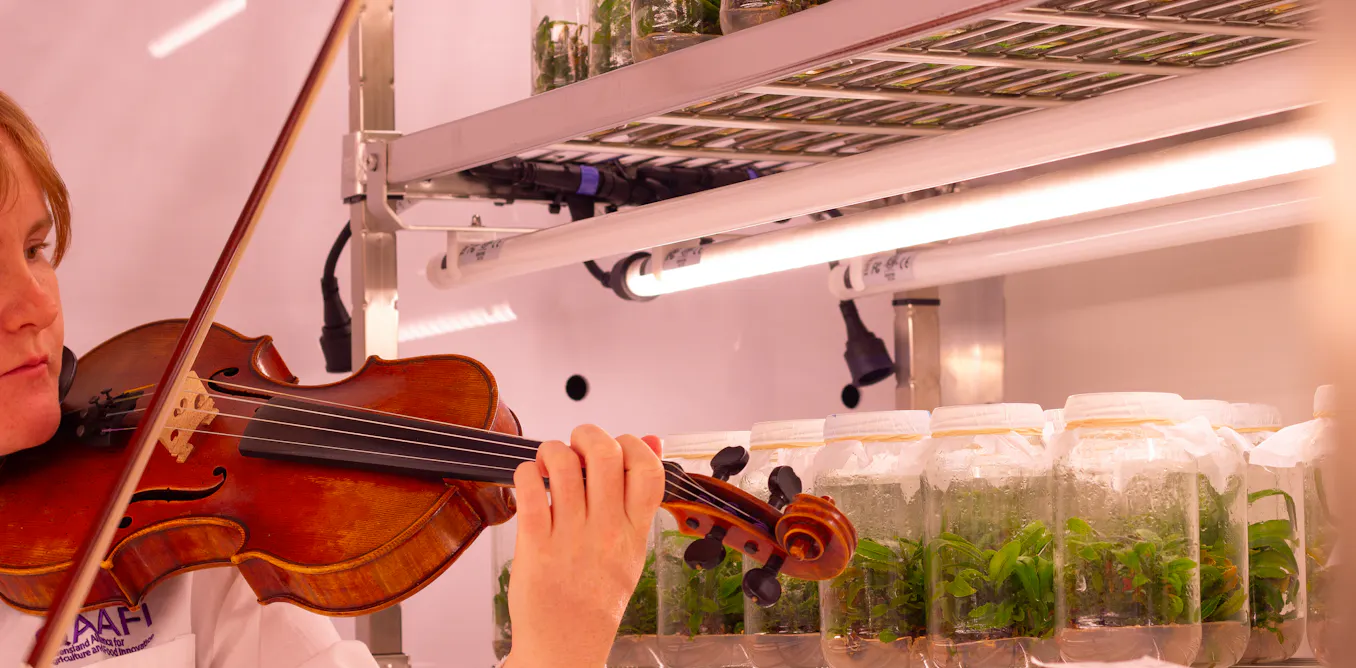
Some people may think it’s nice to listen to music with their plants. But is there any truth to the idea that certain music boosts plant growth?
The notion that music can affect plant growth has intrigued both gardeners and scientists for nearly seventy years, sparking curiosity about whether plants benefit from the melodies humans enjoy. While many enthusiasts play albums like 1976's "Plantasia," crafted explicitly for plants and their caretakers, the scientific community remains cautious about claims that music directly promotes plant health.
One of the earliest and most cited works on this subject emerged in the early 1970s. In 1973, Dorothy Retallack published a book presenting experiments where she observed seemingly divergent plant responses to different music genres, suggesting that classical music enhanced growth while rock music harmed her plants. However, her research lacked rigorous scientific methodology and peer review, leading to skepticism from experts. Despite this, her findings gained widespread public attention and inspired a broader cultural fascination with the idea of plants being sensitive to sound.
Related stories
 ‘Curious Case of Benjamin Button’ review: A sweet and folksy musical that wants to go to Broadway
 Best of the Fest: Giant noses, curious snails and gross medical procedures live on stage - the weird and wonderful Edinburgh Fringe is back to entertain
Emerging Directors Need to Be ‘Brave,’ ‘Curious,’ ‘Pushy’ and ‘Fearless,’ Say Industry Leaders Behind Future Frames Program
That same year, the publication of "The Secret Life of Plants" further popularized the concept of plant sentience and intelligence, venturing into more speculative narratives, including anecdotes of plants communicating in human languages. Though captivating, these stories were met with criticism for their questionable scientific basis and became emblematic of alternative movements during the 1970s rather than established biology.
In the decades that followed, various studies attempted to revisit the question of sound's role in plant development. Unfortunately, many of these investigations replicated earlier methodological issues, including inadequate controls, lack of statistical validation, and overt bias, particularly when involving religious music or chanting. This has made it difficult to draw definitive, reproducible conclusions about the effects of specific musical styles on plants.
More robust research has shifted focus to the physical properties of sound waves rather than musical genres. Sound, fundamentally, is a series of pressure waves traveling through the environment, and it interacts with plant structures such as leaf hairs and stems. Some experiments have demonstrated that plants can respond to these vibrations, for instance, by growing toward the source of running water sounds or by enhancing defense mechanisms when exposed to predator noises. These responses suggest plants can detect and react to environmental cues conveyed through sound waves, though not through any sensory mechanism analogous to human hearing.
Importantly, plants did not evolve to perceive or appreciate music in the human sense. Their evolutionary history spans over 850 million years, originating as simple organisms exposed to natural sounds like rainfall, insect activity, and thunder long before humans existed. Thus, it is plausible that certain sound frequencies or rhythms—such as those resembling natural environmental noises—might influence plant physiology, but this is distinct from the concept of musical appreciation.
The diversity of plant species and their varied evolutionary adaptations further complicate any attempts to generalize the impact of music on growth. A sound or rhythm that may stimulate one species might have negligible or even adverse effects on another. Consequently, claims that specific music can universally boost plant health remain unsubstantiated.
While the romantic idea of serenading plants with music persists among hobbyists and some researchers, the current scientific consensus emphasizes the more nuanced relationship between plants and sound. Plants perceive vibrations and may respond to them in ways that are functional for their survival, but they do not process music as humans do. This distinction underscores the importance of approaching such claims with scientific rigor and differentiating between cultural myths and empirical evidence.
In summary, although the interaction between sound and plant growth is an area of ongoing inquiry, definitive proof that music of any particular genre directly benefits plants remains elusive. Instead, the physical effects of sound waves on plant biology offer a more credible framework for understanding how plants might be influenced by their acoustic environment. For those who enjoy playing music around their plants, the practice may enhance the human experience of caregiving, even if the plants themselves remain indifferent to the tunes.
Full story & global impact
This article was synthesized and rewritten by MusicTop Editorial from reporting published by theconversation.com. Read the publisher's report for the complete source context.
Read original source: theconversation.com