Rebel Rebel the Musical stages David Bowie’s dystopian vision
Published October 6, 2026 · EUROPA
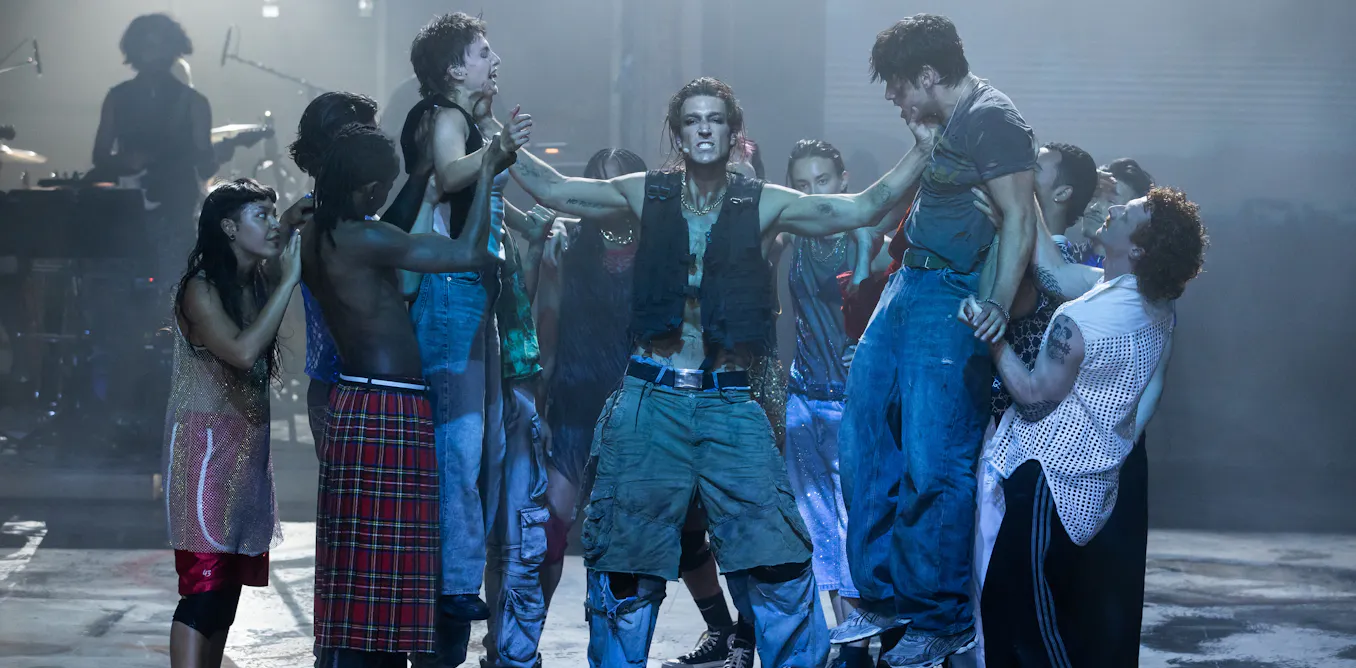
This joyous and emotional musical also has a sombre literary and political background.
A recent theatrical adaptation titled Rebel Rebel harnesses the transformative power of David Bowie’s music to explore a dystopian world where human connections are forbidden. Directed by Belgian theatre artist Ivo van Hove, the musical staged a sold-out run at Germany’s Ruhrtriennale Festival in Bochum, drawing significant interest for its innovative fusion of Bowie’s songs with a politically charged narrative.
The story unfolds in a society governed by an authoritarian regime that prohibits personal relationships and fosters violence through unchecked street gangs. This bleak backdrop serves as a canvas against which the musical’s three central characters—known only as Girl, Boy, and Gang Leader—navigate a landscape marked by repression and conflict. The dynamic between Girl and Boy resonates faintly with the doomed romance of George Orwell’s 1984 protagonists Julia and Winston, reflecting themes of forbidden desire and resistance under surveillance.
Related stories


Rebel Rebel’s conceptual roots trace back to Bowie’s 1974 album Diamond Dogs, which itself drew inspiration from Orwell’s dystopian novel. Although Bowie had initially intended to create a stage adaptation of 1984, copyright limitations prevented this, leading instead to a musical narrative interwoven with his songs. Van Hove’s production channels this legacy, framing the show as both a reflection on authoritarian control and a testament to human resilience.
Musically, the show is notable for its near-exclusive reliance on Bowie’s compositions, performing approximately 25 songs that span diverse phases of his career. The musical arrangement emphasizes emotional authenticity rather than imitation; none of the lead vocalists attempt to replicate Bowie’s iconic voice but instead deliver fresh interpretations. Among the highlights is a reinterpretation of "Starman," which evolves from an intimate duet into a powerful ensemble number accompanied by a live band and choreographed dance, underscored by evocative video imagery of childhood innocence amidst adversity.
The production’s collaborative nature is evident in the equal billing of van Hove alongside choreographer Sidi Larbi Cherkaoui, musical director Henry Hey, and set and lighting designer Jan Versweyveld. Christopher Ash’s video design plays a critical role, employing large screens to project war-torn cityscapes and fragmentary visuals that evoke contemporary global conflicts. While the show stops short of specifying real-world locations or events, the imagery invites audiences to draw parallels with ongoing crises of violence and repression.
Rebel Rebel’s narrative conveys a duality: a stark portrayal of societal decay counterbalanced by moments of hope and human connection. The musical’s sparse dialogue is replaced almost entirely by Bowie’s lyrics, which range from romantic ballads to more cynical reflections on love and society. For instance, the Gang Leader’s rendition of "Modern Love" highlights the irony between the song’s upbeat rhythm and its more misanthropic lyrics, exemplifying the production’s nuanced engagement with Bowie’s work.
Later Bowie compositions from the 1990s and 2000s also feature, with songs like "Slowburn" from the 2002 Heathen album receiving particularly poignant treatment. This number stands out for its intense emotional delivery and striking visual accompaniment, which includes a backdrop of flames that visually amplify themes of destruction and fear. Such moments underline the musical’s ability to connect Bowie’s diverse catalog with the overarching dystopian motif.
The restrained but potent use of Bowie’s songs, combined with van Hove’s meticulous attention to textual meaning, results in a production that foregrounds the lyrical content as much as the spectacle. Van Hove, known for his careful handling of source material, ensures that the words remain central to the audience’s experience, inviting reflection on themes of love, control, and resistance.
While Rebel Rebel’s Bochum run has concluded, there is anticipation that the production could embark on an international tour, potentially reaching audiences across Europe and the UK. Given Bowie’s enduring cultural impact, especially in the UK, such a tour would likely generate considerable interest among theatre-goers and Bowie enthusiasts alike.
In sum, Rebel Rebel represents a compelling marriage of David Bowie’s musical legacy with a contemporary theatrical vision that interrogates power, human connection, and hope within a dystopian framework. Its successful reception in Germany suggests a growing appetite for stage works that blend popular music with politically resonant storytelling.
Full story & global impact
This article was synthesized and rewritten by MusicTop Editorial from reporting published by theconversation.com. Read the publisher's report for the complete source context.
Read original source: theconversation.com