Erik Visits an American Grave, Part 2,217
Published August 25, 2026 · JAZZ
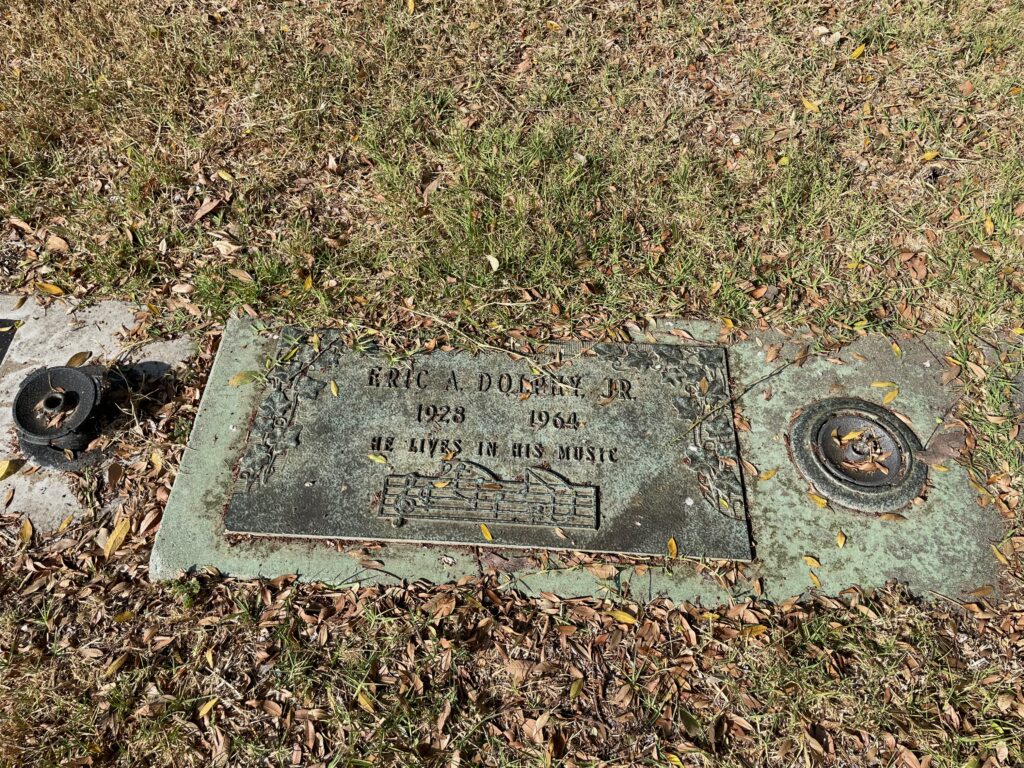
This is the grave of Eric Dolphy. Born in 1928 in Los Angeles, Dolphy was interested in music from the time he was a small child. While he was always interested in blowing instruments and messed around with the clarinet and saxophone as a kid, his first real …
Eric Dolphy emerged from the vibrant Los Angeles music scene of the 1940s to become one of jazz’s most innovative and influential figures. Born in 1928, Dolphy showed an early fascination with wind instruments, initially exploring the clarinet and saxophone before settling on the oboe—a rarity in jazz circles. His early classical music studies, supported by a scholarship to USC’s youth music program, laid a foundation that would deeply inform his complex musical vision.
Dolphy’s formative years in Los Angeles saw him embedded in the local jazz ecosystem, collaborating with established musicians such as drummer Roy Porter. His versatility on clarinet and saxophone made him an asset in various recording sessions prior to his military draft in 1950. Stationed primarily in Colorado, Dolphy continued to develop his craft, attending the Navy’s music school before his discharge in 1953.
Related stories

Upon returning to Los Angeles, Dolphy became a prominent figure in the regional music community, although widespread recognition eluded him until 1958. That year marked a turning point when Chico Hamilton invited Dolphy to join his touring quintet. This engagement propelled Dolphy to New York City’s bustling jazz scene, where his distinct sound quickly garnered attention.
In New York, Dolphy’s association with bassist and bandleader Charles Mingus proved pivotal. Mingus, already a towering presence in jazz, featured Dolphy on seminal recordings such as "Pre-Bird" and "Charles Mingus Presents Charles Mingus." Dolphy’s role in Mingus’s ensemble extended to live performances and politically charged projects like the Newport Rebels album of 1960, which challenged the conservative tendencies of the Newport Jazz Festival.
Dolphy’s connection to John Coltrane dates back to 1954 in Los Angeles. Their enduring friendship culminated in Dolphy joining Coltrane’s band in 1961, where his multi-instrumental talents—particularly on clarinet and alto saxophone—complemented Coltrane’s evolving sound. Their collaborations, including albums like "Live at the Village Vanguard!" and "Africa/Brass," initially polarized jazz critics but have since been hailed for their adventurous spirit and innovation.
Parallel to these collaborations, Dolphy contributed to other landmark recordings. He played bass clarinet and flute on Booker Little’s "Out Front," Abbey Lincoln’s "Straight Ahead," Max Roach’s "Percussion Bitter Sweet," and Ornette Coleman’s groundbreaking "Free Jazz" album. These sessions underscore Dolphy’s integral role in the burgeoning free jazz movement and his broad adaptability across jazz subgenres.
While continuing as a sought-after sideman, Dolphy also forged a path as a bandleader. His early recordings maintained a foothold in hard bop, but he rapidly expanded into more experimental territory. Albums such as "Out There," "Far Cry," and the live recordings at the Five Spot in 1961 and 1963 are considered some of the finest in live jazz history. Notably, Dolphy was among the first jazz musicians to record solo saxophone performances, pioneering a format that was rare for his era.
Tragically, Dolphy’s promising trajectory was cut short in 1964. Suffering from undiagnosed diabetes, he collapsed during a European tour in Berlin. Conflicting reports from lawyersgunsmoneyblog.com suggest that medical mismanagement may have contributed to his untimely death at just 36 years old. His passing deprived the jazz world of a visionary whose further evolution could only be imagined.
At the time of his death, Dolphy had recently completed "Out to Lunch," an album now revered as a masterpiece of modern jazz. Featuring luminaries such as Freddie Hubbard, Tony Williams, Bobby Hutcherson, and Richard Davis, the record epitomizes Dolphy’s synthesis of jazz improvisation and contemporary classical influences. Posthumous releases like Andrew Hill’s "Point of Departure" also include Dolphy’s contributions, cementing his enduring influence.
Eric Dolphy’s final resting place is Angelus Rosedale Cemetery in Los Angeles. His legacy persists through a discography that challenged and expanded the boundaries of jazz, inspiring generations of musicians to explore new sonic possibilities. While details about some aspects of his life remain limited, Dolphy’s recorded work continues to be a vital touchstone for understanding the evolution of 20th-century jazz.
Full story & global impact
This article was synthesized and rewritten by MusicTop Editorial from reporting published by lawyersgunsmoneyblog.com. Read the publisher's report for the complete source context.
Read original source: lawyersgunsmoneyblog.com