Learning Jazz Pianist Style with Cross-Attention Conditioning
Published October 5, 2026 · JAZZ
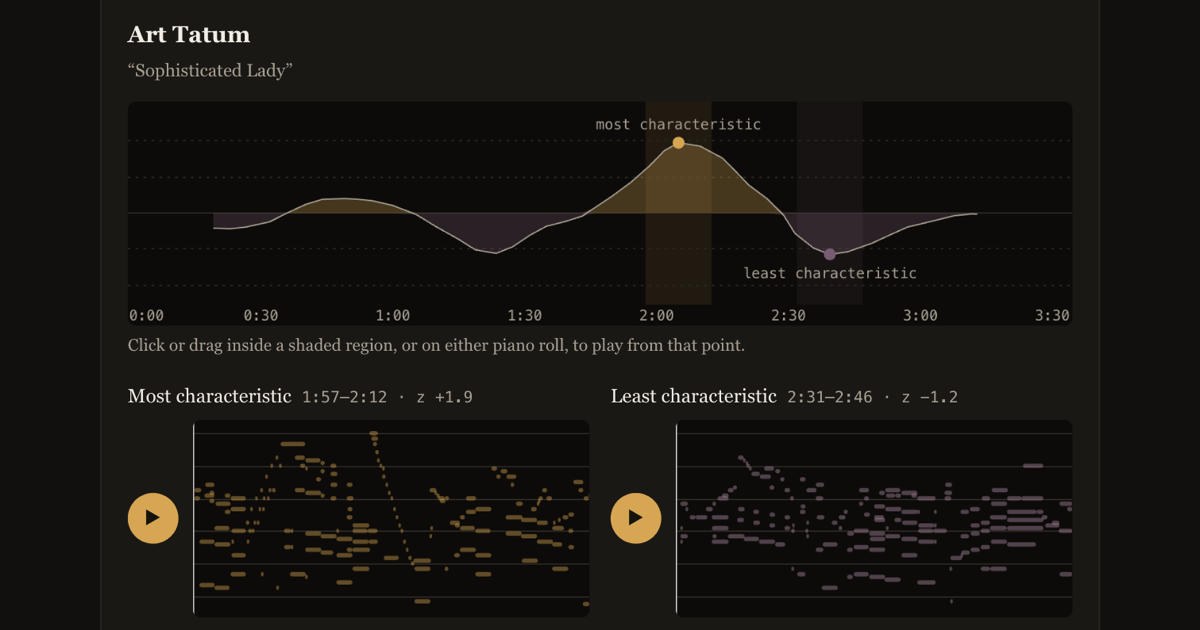
A music model continuing performances in the style of twelve jazz pianists, a blindfold test, and the moments where each pianist's style is most recognizable. ISMIR 2026.
The quest to digitally capture the essence of jazz piano has taken a significant step forward with a new artificial intelligence model capable of continuing performances in the distinctive styles of legendary pianists. This development, detailed on almostimplemented.github.io, marks a novel approach to stylistic music generation, inspired by past efforts to characterize and recreate individual musician signatures.
Jazz pianist and composer Dick Hyman's 1994 collection, which featured original études designed to embody the idiosyncrasies of masters from Scott Joplin to Bill Evans, provided a conceptual foundation. Unlike mere transcriptions, Hyman's work distilled each artist’s signature techniques—such as Art Tatum’s rapid dual-hand runs or Erroll Garner’s characteristic left-hand strumming—into new compositions. The current project builds upon this principle, aiming not just to identify a player but to generate new music that convincingly mimics their style.
Related stories
 Lana Del Rey stops to give money to distressed woman on the street after learning she was fleeing 'an abusive relationship'
Cliff Richard says he’s “learning reggae” for new version of ‘The Lord Is My Shepherd’ for Christmas single
The research team focused on twelve jazz pianists, including the aforementioned Tatum, Garner, and Peterson, as well as Hyman himself. They fine-tuned a preexisting transformer model, known as Aria, which was pretrained on a large corpus of piano MIDI data. By integrating a gated cross-attention mechanism conditioned on a learned embedding representing each pianist, the model could maintain stylistic fidelity throughout generated sequences.

A critical challenge was assessing whether the AI truly captured individual styles. Traditional evaluation metrics like perplexity proved insufficient, as they failed to discriminate stylistic nuances when predicting the next note. Instead, the team employed pianist classifiers sliding over generated continuations to see if the output aligned with the intended artist’s style. Results showed that conditioning on pianist embeddings raised correct identification rates to 70%, compared to 37% without such conditioning. Further, classifiers trained exclusively on AI-generated music could recognize authentic recordings with 95% accuracy, underscoring the generated samples’ stylistic authenticity.
Demonstrations included continuations of a shared musical prompt—opening bars of “Ain’t Misbehavin’”—rendered in twelve different pianistic voices. Notably, each rendition exhibited unique rhythmic density and phrasing characteristic of the respective artist: for instance, Garner’s output was notably compact in duration while Cedar Walton’s extended leisurely. These differences emphasize how temporal dynamics contribute to a pianist’s signature.
The team also provided visualizations showing classifier confidence over time, highlighting moments where a particular pianist’s style was especially pronounced or ambiguous. In some cases, the model’s certainty surpassed that found in original recordings, illuminating distinct stylistic markers. Such granular analysis offers insights into how AI models internalize and replicate complex musical identities.
From a technical perspective, Aria’s architecture was augmented by inserting cross-attention layers in its deeper transformer blocks, which attend to the pianist embeddings at every generation step. This design ensures consistent style conditioning without degradation over time, contrasting with simpler prompt-based methods whose influence fades. The model’s learned gating mechanism gradually increases conditioning influence from a minimal starting point, balancing between pretrained general piano playing and specialized stylistic nuances.
Importantly, the twelve pianists selected for this study were those whose styles were most readily distinguishable by pretrained classifiers from the PiJAMA dataset. However, imitation quality varied significantly across artists; for example, continuations attributed Hank Jones and Dick Hyman nearly 96% of the time, while Cedar Walton’s style proved more challenging with a 29% attribution rate. This variation suggests that certain stylistic elements may be more amenable to computational modeling.
The AI-generated samples are derived from MIDI transcriptions of commercial recordings, which inherently limit expression details such as dynamics and pedaling. Consequently, playback is rendered on a sampled piano with simpler sound characteristics than original performances. The researchers emphasized that the continuations are synthetic creations rather than reproductions of existing solos, verified by comparisons showing less resemblance to training data than real held-out recordings.
While classifier judgments currently serve as the primary evaluation method, the research acknowledges the need for human listening studies to validate perceived authenticity and stylistic accuracy. This next step could further bridge the gap between computational analysis and experiential music appreciation.
Overall, this project exemplifies how AI can extend beyond recognition to creative emulation, capturing the subtleties of individual jazz pianists’ approaches. It opens promising avenues for music generation, preservation of artistic legacies, and interactive tools for education and composition. Details on implementation and sample outputs are available through the researchers’ online platform, inviting the music community to explore this intersection of technology and artistry.
Full story & global impact
This article was synthesized and rewritten by MusicTop Editorial from reporting published by almostimplemented.github.io. Read the publisher's report for the complete source context.
Read original source: almostimplemented.github.io