Nicolás Jaar: Interview & Performance at Democracy Now!
Published October 7, 2026 · US
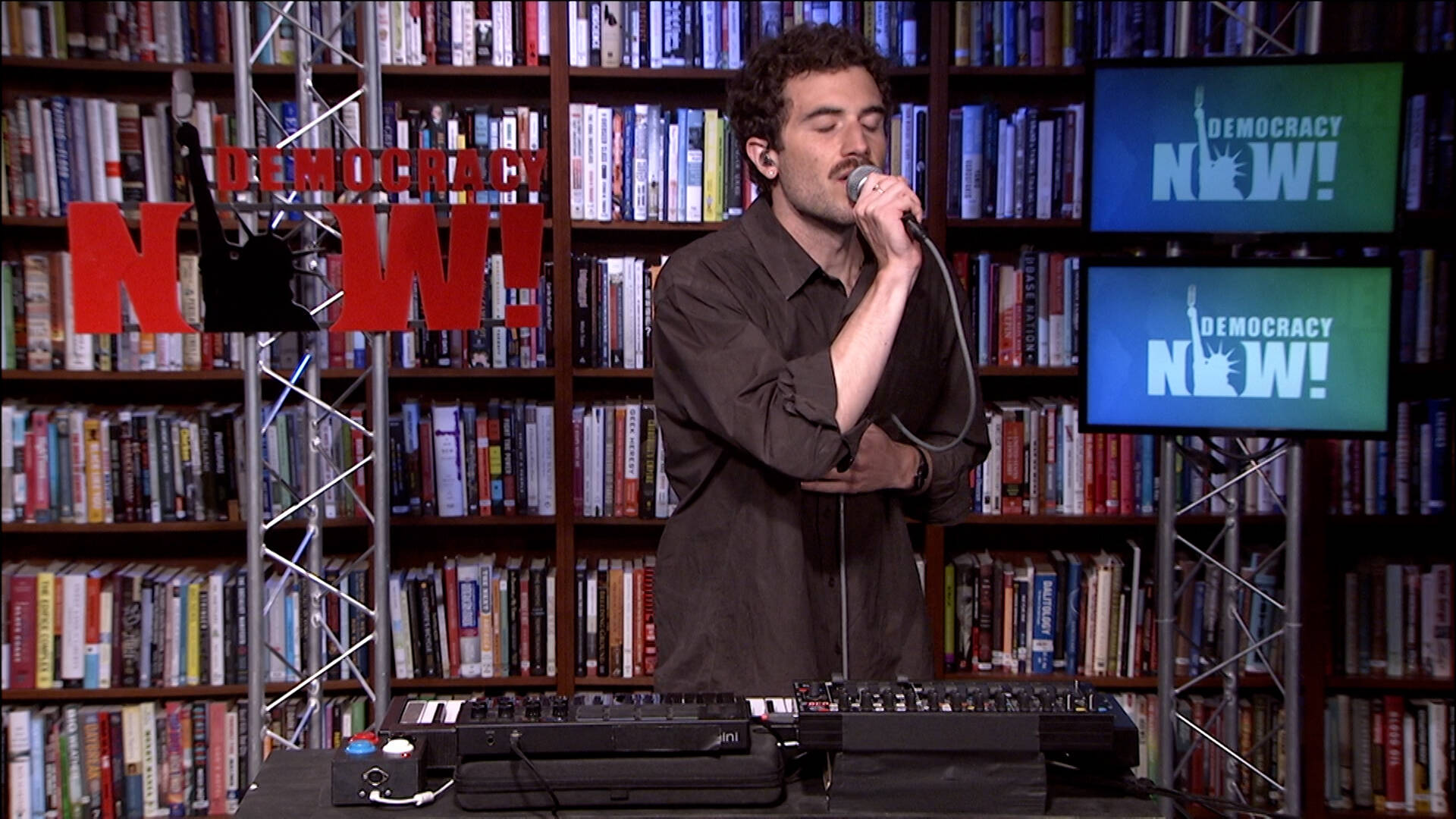
Celebrated Chilean American composer, musician and electronic music producer Nicolás Jaar recently stopped by the Democracy Now! studio to perform and talk about his work. He has released seven solo albums, including Piedras 1 and Piedras 2, both of which cam…
Nicolás Jaar, the distinguished Chilean American composer and electronic music producer, recently appeared on Democracy Now! to discuss his evolving artistic journey and political convictions. Known for his innovative solo albums and cinematic scores, Jaar shared insights into his creative process, familial roots, and activism amid ongoing global conflicts.
Jaar, who has released seven solo albums to date, including the critically noted Piedras 1 and Piedras 2 which debuted in 2025, brings a rich cultural perspective shaped by his diverse background. His father, Alfredo Jaar, is a prominent Chilean conceptual artist and architect with Palestinian lineage tracing back to Bethlehem. His mother, Evelyne Meynard, is a French Chilean writer and former dancer. This blend of artistic and cultural influences informs Nicolás Jaar’s work and worldview.
Related stories
Würth-Preis der Jeunesses Musicales Deutschland geht an Nicolás Pasquet
 Albert Serra – In Conversation With China’s Bi Gan – and Carla Simón, Nicolás Méndez, Turbo Shorts Capture Spain’s Creative Take-Off at Shanghai
 Carla Simón, Nicolás Méndez, Turbo Shorts Capture Spain’s New Wave International Lift-Off
During the interview, Jaar reflected on the complex history connecting Chile and the United States, emphasizing the legacy of the 1973 Chilean coup d’état. He highlighted how this event, often overshadowed in American discourse, remains a critical moment of U.S. interventionism in Latin America with enduring repercussions. Jaar also drew parallels between these historical dynamics and contemporary issues such as the militarization of Indigenous territories in Chile and the broader impacts of U.S. foreign policy in the Western Hemisphere.
Related music video
Selected for this story · Published within the last two years
Jaar’s activism extends into his public statements on current international conflicts, particularly regarding Palestine. Drawing on his heritage and personal experiences, including his first visit to the West Bank in 2017 prompted by a musical invitation, Jaar described witnessing the realities of apartheid and systemic oppression firsthand. He has been vocal about the U.S. government's role in providing technological and military support to Israel, linking these actions to broader systems of control and surveillance.
In a notable reference to the intersection of art and politics, Jaar discussed a recent controversy involving rapper Macklemore, who was removed from Ed Sheeran's UK tour after publicly expressing support for Palestine. Jaar framed this incident as part of a larger pattern of silencing Palestinian voices and suppressing artistic activism. He underscored the importance of musicians using their platforms to shed light on ongoing injustices, even in the face of institutional pushback.
Jaar also connected the dots between different forms of state violence, noting the shared technologies and tactics used in policing and militarization from the United States to Chile to Palestine. He cited examples such as Israeli-made drones employed against the Indigenous Mapuche communities in Chile, illustrating how these mechanisms of control transcend national borders.
Democracy Now!’s host Amy Goodman invited Jaar to perform during the visit, and he chose to interpret "Sólo le Pido a Dios," a politically charged song popularized by the Argentine folk singer Mercedes Sosa during the era of Latin American dictatorships. Jaar adapted the lyrics to resonate with contemporary struggles, emphasizing themes of memory, resistance, and solidarity. The performance highlighted music’s enduring power as a tool for emotional expression and social change.
Looking ahead, Jaar revealed plans for an electroacoustic live show featuring collaborations with cellist and drummer Patrick Higgins. This experimental concert promises to explore new sonic territories, underscoring Jaar’s commitment to pushing artistic boundaries while engaging with urgent social issues.
Jaar’s appearance on Democracy Now! coincided with the 25th anniversary of the September 11 attacks, prompting broader reflections on the intersections of terror, violence, and geopolitical power. His perspectives contribute to ongoing conversations about the global consequences of U.S. foreign policy and the role of artists as witnesses and commentators in turbulent times.
Through his multifaceted career and activism, Nicolás Jaar exemplifies how music can serve as a conduit for cultural identity, political critique, and collective healing. His dialogue with Democracy Now! underscores the vital connection between art and resistance in an interconnected world.
Full story & global impact
This article was synthesized and rewritten by MusicTop Editorial from reporting published by democracynow.org. Read the publisher's report for the complete source context.
Read original source: democracynow.org