dennis vanderbroeck creates settings for the moments that bring us together
Published October 18, 2026 · US
moving between fashion, theater, and music, the dutch spatial designer treats architecture as a framework for encounter, where the relationship between performers and audiences matters as much as the space itself. The post dennis vanderbroeck creates settings…
Dennis Vanderbroeck, a Dutch spatial designer with a theater background, is redefining how audiences experience live events across music, fashion, and performance. His work centers on the interaction between performers and spectators, treating architectural spaces not merely as backdrops but as active participants in shaping collective moments.
At recent Milan and Paris fashion weeks, Vanderbroeck delivered strikingly distinct spatial concepts that emphasized communal engagement and dynamic movement. For Diesel, his design employed rigid scaffolding structures to create a performative environment that heightened the tension between individual models and the surrounding group, fostering a sense of disruption and shared presence.
Related stories

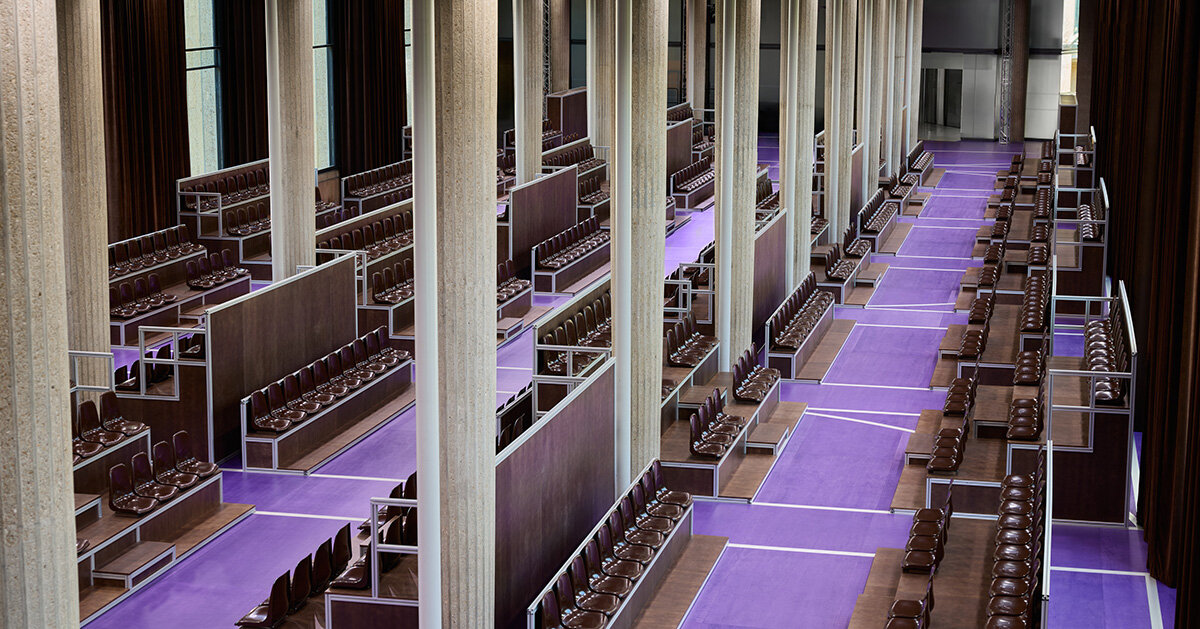
In contrast, his inaugural collaboration with Miu Miu for the Spring/Summer 2027 show embraced intimacy and transition. Featuring compact bleacher seating and a narrow catwalk, the setup evoked the closeness of 1990s runway presentations. This arrangement invited spectators into close proximity with models, enhancing the immediacy of the experience while anticipating the space's forthcoming repurposing for an exhibition by filmmaker Alice Diop during Art Basel Paris in October 2026. Vanderbroeck’s modular design enabled a fluid reconfiguration, illustrating his concept of a “dynamic stage” adaptable to evolving contexts.
The fusion of theater and spatial design remains a cornerstone of Vanderbroeck’s approach. His work for Issey Miyake’s OPEN STUDIO at Tate Modern, for instance, utilized the museum’s circular concrete tanks to explore varying degrees of audience-performer closeness. This progression from collective embrace to intimate one-on-one encounters underscored his commitment to crafting environments that facilitate emotional and physical connection.
Vanderbroeck’s engagement with the music sector further exemplifies his interdisciplinary methodology. Collaborating with Rosalía on her Lux Tour, he integrated influences from fashion, popular culture, theater, and fine art to create a setting that amplified the live performance's energy. This project encapsulated his comprehensive practice, blurring boundaries between artistic disciplines to enrich the concert experience.
Despite the proliferation of digital documentation and social media sharing, Vanderbroeck prioritizes the authenticity of in-person engagement. He designs spaces that emphasize physical presence and sensory interaction rather than how they might appear through a camera lens. While acknowledging the significance of recorded media in preserving memories, he distinguishes the photograph as a separate entity from the ephemeral, collective event.
His fascination with unpredictability in live settings is deeply rooted in his theatrical origins. Vanderbroeck reflects on the unpredictability of audience reactions, highlighting that while spatial design can set the scene, the ultimate experience unfolds uniquely each time. This understanding informs his philosophy that design is a facilitator rather than a controller of shared moments.
Through his diverse portfolio, Dennis Vanderbroeck demonstrates an ongoing exploration of the tension between individual and group dynamics within live events. His spatial interventions foster encounters that are simultaneously structured and open-ended, encouraging participation without dictating responses. By reimagining the architecture of experience, Vanderbroeck continues to impact how fashion, music, and performance resonate in physical spaces.
Full story & global impact
This article was synthesized and rewritten by MusicTop Editorial from reporting published by designboom.com. Read the publisher's report for the complete source context.
Read original source: designboom.com