“Hydrofeminism” and leaky saints feature in Everything Moist Seems Alive installation
Published October 22, 2026 · US
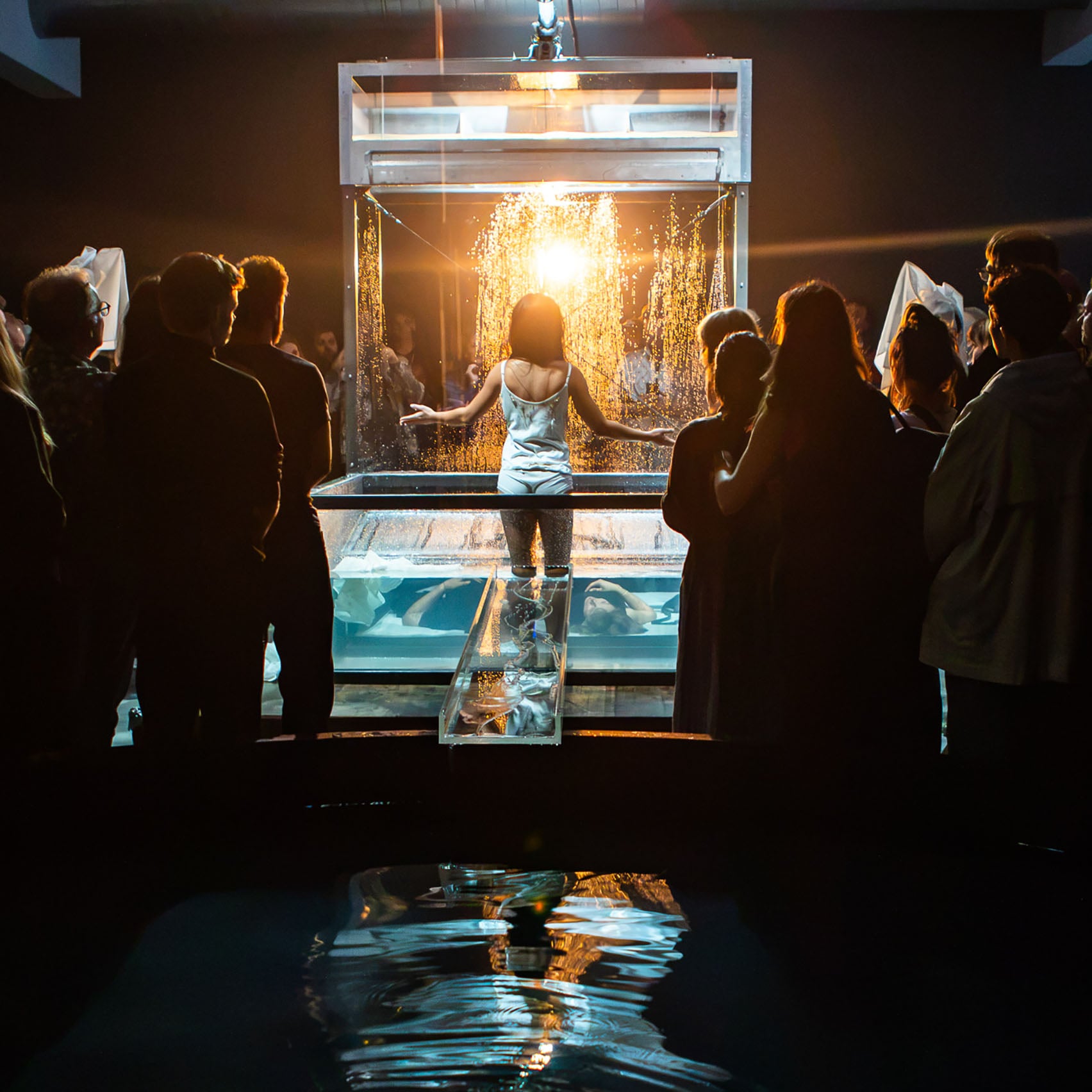
The technical minimalism of artist Boris Acket and the maximalism of fake fashion house Maison the Faux come together in the installation Everything Moist Seems Alive at MU Hybrid Art House during Dutch Design Week. The multidisciplinary creatives worked with…
During Dutch Design Week 2026 in Eindhoven, the MU Hybrid Art House presents Everything Moist Seems Alive, an immersive installation that merges art, design, and ecological philosophy through the medium of water. This large-scale work is the product of a creative partnership between artist Boris Acket and the experimental fashion collective Maison the Faux.
The installation occupies a shadowy, cavern-like space where visitors encounter a network of interconnected kinetic water sculptures. These structures cycle through phases of containment and release, choreographing a continuous aquatic movement supported by clear piping. Above this watery architecture loom monumental video projections of humanoid figures, known as the “leaky saints,” which appear to ooze various liquids from eyes and pores, evoking visceral human bodily fluids.
Related stories

This visual motif draws inspiration from the concept of hydrofeminism, a philosophical framework developed by cultural theorist Astrida Neimanis. Her 2012 essay argues for considering the human body as fundamentally composed of water, emphasizing interconnections between physiology, ecology, and social identity. The installation’s creators engaged deeply with these ideas over two years, seeking to embody water’s omnipresence in human life and the environment.
The leaky saints stand as a physical manifestation of this theory, their fluid emissions symbolizing human corporeality’s inherent liquidity. Beyond these figures, the installation features five distinct "water bodies," each representing a unique interaction with water. Central to the exhibition is The Womb, a large circular basin symbolizing water as the origin of life, complemented by The Well, The Whirl, The Wake, and The Waterfall—each sculptural element responding to water’s various states and movements.
The Well functions as a pumping system that circulates water through the installation, setting the stage for The Waterfall’s dramatic transformation from a gentle drip into a powerful torrent. The Whirl incorporates a spinning white cloth animated by water currents, while The Wake releases steam by dripping water onto a heated surface. Together, these components create a dynamic ecosystem that reflects natural water cycles and human engagement with them.
Architectural references also inform the installation’s design. The piping system evokes everyday sanitation infrastructure, grounding the poetic water forms in practical urban realities. Adorning the pipes are ornate 3D-printed metallic elements inspired by gothic gargoyles, which historically served to channel rainwater away from buildings, blending functional ornament with symbolic meaning.
Maison the Faux’s maximalist visual language contrasts with Boris Acket’s technical minimalism, resulting in a striking collision of aesthetics. This partnership highlights the tensions between elaborate decoration and streamlined engineering, offering a richly textured sensory experience. Maison the Faux, known for their multidisciplinary approach that blurs fashion, performance, and design, infuse the installation with theatricality and sculptural excess.
At the installation’s entrance, a water bar invites visitors to taste different varieties of water or contribute samples to the system, creating an interactive prelude to the main exhibition. This space also features a suspended sculpture resembling abstract flesh, composed of mixed materials and moist, sac-like forms, setting a tactile and organic tone.
Everything Moist Seems Alive is further animated by live performances from the Dutch National Opera and Ballet, who periodically bring the installation to life with choral rituals. These performances enhance the spiritual and mythical atmosphere, linking back to ancient Greek myths and the symbolic power of rivers, which inspired the installation’s narrative framework.
While details about the broader context of Dutch Design Week 2026 remain limited, this installation stands out as a provocative exploration of water’s multifaceted role in human culture and embodiment. By synthesizing cutting-edge design, performative art, and ecological theory, the creators invite audiences to reconsider their relationship with this essential yet often overlooked element.
Full story & global impact
This article was synthesized and rewritten by MusicTop Editorial from reporting published by dezeen.com. Read the publisher's report for the complete source context.
Read original source: dezeen.com