How George Clinton’s Mothership landed onstage in 1976
Published November 5, 2026 · US
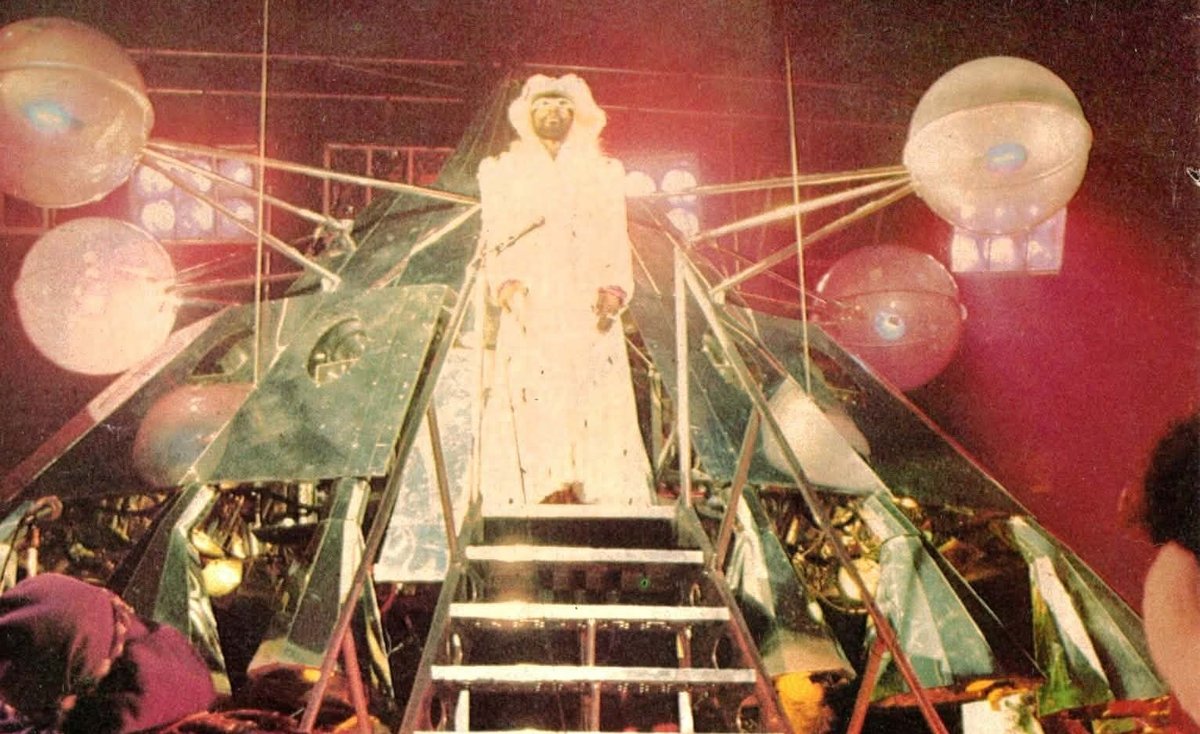
Fifty years after its spectacular debut, George Clinton’s smoke-spewing spaceship remains a marvel of live-music technology and Afrofuturist imagination
Half a century ago, George Clinton transformed live music with the debut of the Mothership, a pioneering stagecraft marvel that blended high-concept Afrofuturist imagery with cutting-edge theatrical engineering. First unveiled in 1976, this 1,500-pound aluminum-and-glass spaceship became an emblem not only of Clinton’s Parliament-Funkadelic collective but also of Black cultural expression and the evolution of concert spectacle.
Conceived during the height of Clinton’s career surge in the 1970s, the Mothership was more than a mere prop; it was the physical manifestation of Clinton’s visionary fusion of funk music and sci-fi themes. Drawing inspiration from television phenomena like Star Trek—where African Americans were portrayed in empowered roles such as Lieutenant Uhura—the ship symbolized a future where Black identities transcended societal limitations. This conceptual framing resonated deeply with audiences, offering a compelling narrative of liberation and imagination amidst the era’s social challenges.
Related stories

The creation of the Mothership involved collaboration with Tony Award-winning Broadway designers Jules Fisher and Peter Larkin, who engineered a roughly 20-foot-wide craft that integrated metal, plastic, and glass components. The ship featured a 241-pound landing ladder and was equipped to emit smoke and fireworks, enhancing its dramatic descent onto stages. The complexity of the design necessitated an extensive crew—around 100 roadies and stagehands—to assemble, disassemble, transport, and maintain the structure across varied venues nationwide.
At a time when live shows were beginning to embrace more elaborate staging, the Mothership set new standards for performance immersion. Its influence can be traced forward to the grandiose productions of contemporary arena tours by artists like Taylor Swift, U2, and BTS. Engineering challenges were considerable: the ship’s mechanical actuators relied on hydraulic systems still considered rudimentary by today’s standards, and safety regulations for touring sets were minimal. Despite these hurdles, the Mothership operated reliably throughout its original run until 1981.
The spectacle of Clinton emerging from the descending spaceship captivated audiences, generating an electrifying atmosphere that redefined concert experiences. Practical adjustments followed early performances, such as adding a handrail to ensure Clinton’s safety amid audience fervor and utilizing dry ice for smoke effects to maintain breathable air on stage.
Following a period of retirement and subsequent neglect, the Mothership was revived in the 1990s alongside a resurgence of Parliament-Funkadelic’s popularity. A replica ship reintroduced the iconic landing at live shows, including a memorable 1997 Boston concert featuring future hip-hop legends alongside Clinton’s ensemble. This iteration eventually found a permanent home at the Smithsonian’s National Museum of African American History and Culture, cementing its status as a cultural and historical artifact.
The Mothership’s enduring legacy lies in its demonstration that live musical performances can transcend auditory experiences to become immersive multimedia storytelling events. It embodied a synthesis of sound, visual artistry, and narrative that expanded the possibilities of stagecraft and audience engagement.
Continuing the tradition, Parliament-Funkadelic unveiled a third Mothership in 2023, which debuted at the Essence Festival of Culture in New Orleans. This new vessel retains the spirit and mechanical rigor of its predecessors, underscoring the lasting appeal and technical ambition of Clinton’s original vision.
George Clinton’s Mothership remains a landmark in music history, reflecting both the innovation of its era and the power of Afrofuturist ideals to inspire and transport audiences. Its impact transcends funk music, influencing the design and storytelling of live performances across genres and generations.
Full story & global impact
This article was synthesized and rewritten by MusicTop Editorial from reporting published by scientificamerican.com. Read the publisher's report for the complete source context.
Read original source: scientificamerican.com