Bob Dylan meets Pope Leo XIV at the Vatican wearing a hood, united by their opposition to war
Published November 5, 2026 · US
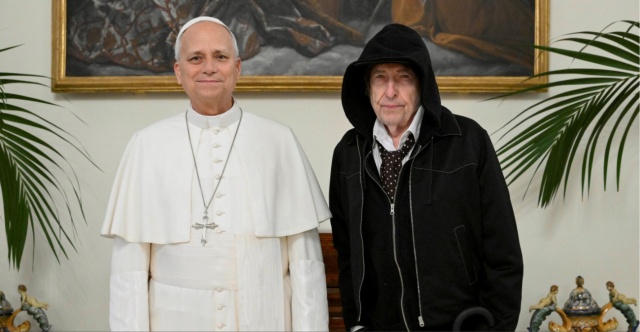
The 85-year-old singer-songwriter exchanged his autobiography for a rosary, almost 30 years after meeting John Paul II The post Bob Dylan meets Pope Leo XIV at the Vatican wearing a hood, united by their opposition to war appeared first on ProtoThema English.
On November 4, 2023, Bob Dylan, the iconic American singer-songwriter, held a rare private audience with Pope Leo XIV at the Vatican’s Apostolic Palace. The meeting occurred against the backdrop of Dylan’s ongoing Rough and Rowdy Ways tour in Italy, marking a symbolic intersection between music, faith, and political conscience.
At 85 years old, Dylan’s presence at the Vatican was notable not only for his stature in music history but also for his distinctive appearance. The musician arrived wearing a black hoodie with the hood up, a departure from the formal dress typically expected within the Vatican’s historic walls. Despite this unconventional look, the encounter between Dylan and the 71-year-old pontiff was characterized by mutual respect and the exchange of meaningful tokens.
Related stories

Pope Leo XIV presented Dylan with a rosary, a gesture steeped in religious significance, while Dylan reciprocated by gifting the pontiff a copy of his 2004 autobiography, Chronicles: Volume One. Although the conversation between the two was brief and its specifics undisclosed, the meeting resonated deeply due to their shared commitment to peace and opposition to war.
Related music video
Selected for this story · Published within the last two years
This connection is rooted in Pope Leo XIV’s public admiration for Dylan's anti-war sentiments, particularly through the pope’s reference to Dylan’s lesser-known 1963 song "Go Away You Bomb," which critiques nuclear armament. The pontiff cited Dylan’s lyrics in the foreword to a Vatican publication focused on peace and disarmament, using the artist’s words as a powerful reminder of the perils of global militarization.
The timing of this meeting is significant, as Pope Leo XIV has been vocal about the need for diplomacy and peaceful conflict resolution, especially concerning tensions in the Middle East. His stance has drawn criticism from political figures, including former U.S. President Donald Trump, yet the pope remains steadfast in promoting dialogue over confrontation.
Dylan’s own spiritual journey adds layers of complexity to this encounter. Born Robert Allen Zimmerman into a Jewish family, Dylan experienced a profound evangelical Christian awakening in the late 1970s, an episode he has recounted as a transformative religious experience. This phase influenced several of his albums, which embraced Christian themes, before he later adopted a more private relationship with faith.
This was not Dylan’s first encounter with a pontiff. In 1997, he performed at the National Eucharistic Congress in Italy in the presence of Pope John Paul II. That event featured Dylan delivering multiple songs with spiritual and social resonance, followed by a personal exchange with the pope. The lasting image of that meeting underscored Dylan’s unique place at the crossroads of popular music and religious symbolism.
The Vatican has a history of engaging with American music artists, as seen with singer Jewel’s participation in a 1998 Christmas concert. Jewel, who previously toured with Dylan, represents another thread connecting contemporary music with Vatican cultural events.
Nearly three decades after his encounter with John Paul II, Dylan’s visit to meet Pope Leo XIV highlights an enduring rapport between the artist’s messages and the Church’s mission of peace. While details of their latest conversation remain limited, the symbolism of this meeting underscores the continued relevance of cultural figures in global conversations about war, faith, and reconciliation.
Full story & global impact
This article was synthesized and rewritten by MusicTop Editorial from reporting published by en.protothema.gr. Read the publisher's report for the complete source context.
Read original source: en.protothema.gr