Is She the New Britney Spears—Or the New Lou Reed?
Published July 30, 2026 · WORLD
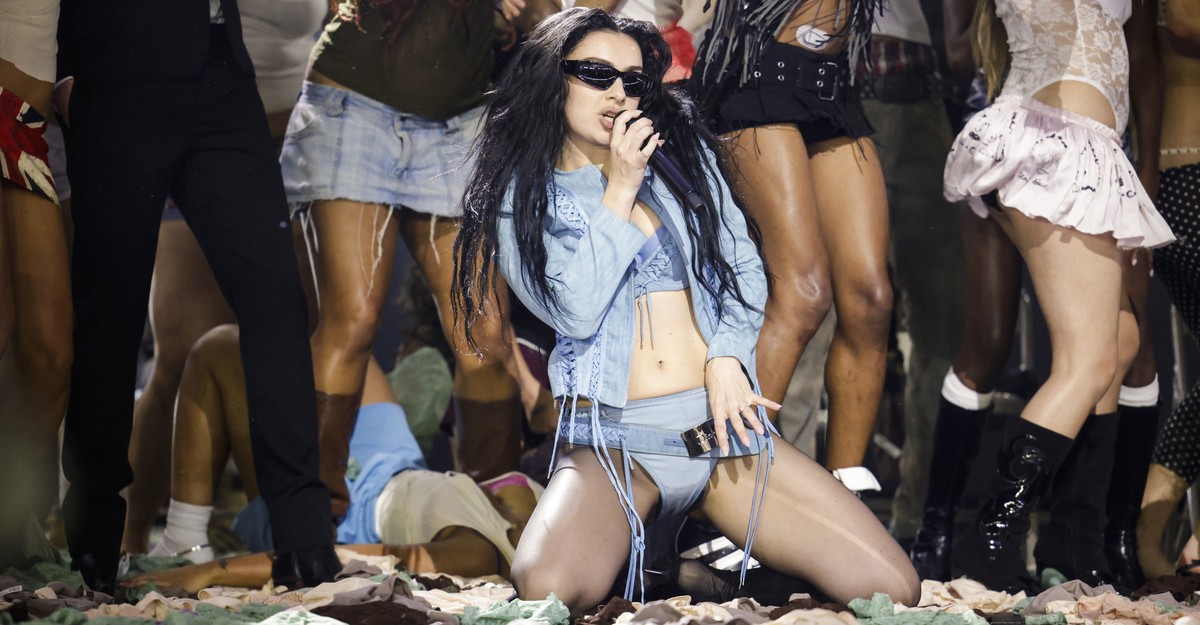
Charli XCX’s new album is a broadside against overthinking the artistic process.
Charli XCX has returned with an album that challenges prevailing attitudes toward artistic productivity and quality in contemporary pop music. Released in 2024, her new project Music, Fashion, Film emerged from a sudden creative surge experienced during last fall’s Paris Fashion Week. This concise, 30-minute record serves as a direct response to critics who argue she has oversaturated the market with a relentless output following her acclaimed 2024 album Brat.
For years, Charli XCX has been recognized as one of pop’s most innovative voices, blending cybernetic dance-pop with an art-school sensibility. However, her prolific release schedule—spanning remix projects, soundtrack contributions, acting roles, and extensive promotional efforts—sparked concerns about diminishing returns. Music, Fashion, Film confronts these critiques head-on by embracing a philosophy that more art and more creation can be a virtue rather than a flaw.
Related stories



Musically, the album marks a notable shift, drawing heavily from the sonic palette of the Velvet Underground, a seminal rock band led by Lou Reed. The influence is evident not only in Charli’s vocal delivery, which recalls Reed’s distinctive sing-talk style, but also in the production choices. Collaborators A.G. Cook and Finn Keane incorporate thin, vintage-style guitars and steady, metronomic rhythms reminiscent of the Velvet Underground’s characteristic sound. The album cover itself features iconic figures such as filmmaker Martin Scorsese, fashion designer Marc Jacobs, and John Cale, the multi-instrumentalist known for his experimental approach within the Velvet Underground.
This connection to the Velvet Underground offers a reframing of Charli’s ongoing engagement with the poptimism debate—the cultural conversation about valuing accessibility in pop music versus the pursuit of artistic challenge. Much like Reed and his bandmates, Charli occupies a space that blurs these boundaries, aspiring to create work that is both innovative and commercially appealing. Songs on Music, Fashion, Film express this duality, with tracks like "Playboy Bunny" aiming for catchy resonance akin to iconic cultural symbols.
Among the album’s highlights are "SS26," a track that melds ethereal guitars with haunting vocals reflecting contemporary anxieties, and "Card Declined," which uses distorted textures to convey the emptiness of consumer habits. The closing number, "Yeah," distills the creative process into a sonic narrative, balancing moments of hesitation and resolution through shifting tempos and minimalist surf-rock riffs.
Nonetheless, the album is not without its uneven moments. Some lyrics come across as unfocused or overly casual, detracting from the potential emotional impact. For example, the opening line of "Wink Wink" includes a provocative statement that some may find jarring or gratuitous. Meanwhile, "2007" offers a nostalgic glance backward but stops short of delivering a compelling twist or deeper insight.
The project also features a spoken-word segment by director David Cronenberg, who reflects on the nature of artistic legacy. He suggests that creators should prioritize the act of making over concerns about enduring fame or posterity. This message aligns with Charli’s prolific ethos and her willingness to embrace imperfection as part of the creative journey.
Charli’s choice to align herself with figures like Scorsese, Jacobs, and Cale on the album artwork underscores a commitment to relentless creation. These individuals represent models of productivity and long-term influence despite periods of inconsistency or critical skepticism. However, this 20th-century model of artistic output contrasts with the digital era’s challenges, where an abundance of content can dilute cultural significance.
While the internet has democratized creation and distribution, it has also fostered an environment saturated with mediocre offerings. Charli’s new album highlights this tension, advocating for the value of continuous artistic engagement while implicitly questioning how to maintain quality amid quantity. Her work invites listeners to reconsider the boundaries of pop music innovation and the role of prolific output in shaping contemporary culture.
Details about further promotional plans or subsequent projects from Charli XCX remain limited at this time. Nevertheless, Music, Fashion, Film stands as a provocative statement in her evolving discography, reaffirming her position as a boundary-pushing artist unafraid to challenge expectations and redefine what pop can encompass.
Full story & global impact
This article was synthesized and rewritten by MusicTop Editorial from reporting published by theatlantic.com. Read the publisher's report for the complete source context.
Read original source: theatlantic.com