The Most Hilarious Bloopers From the Robot Games in China
Published August 25, 2026 · WORLD
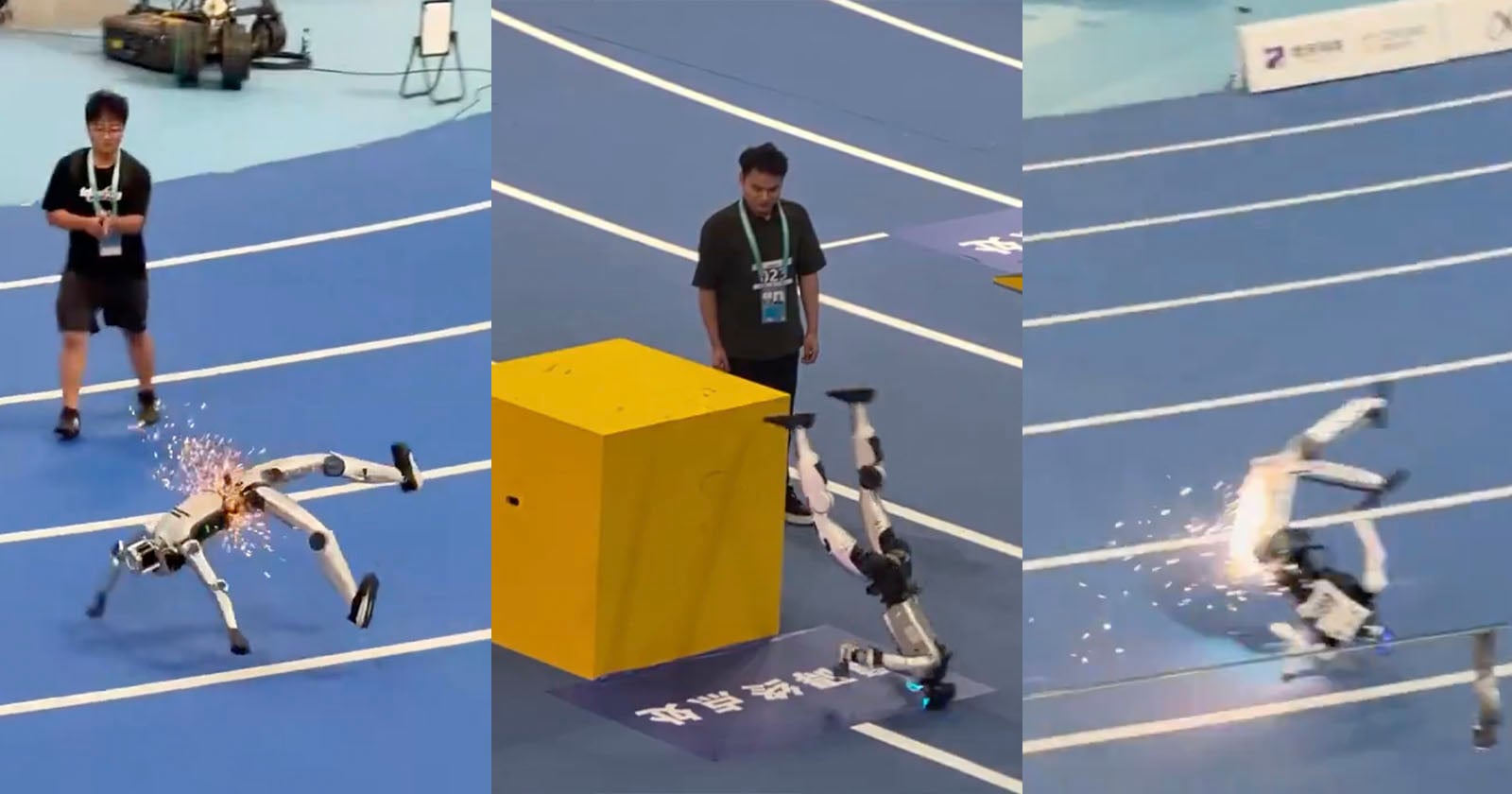
The 2026 World Humanoid Robot Games are being held in Beijing this week, a competition that sees robots compete in track-and-field-style events. [Read More]
This week, the city of Beijing became the center stage for the 2026 World Humanoid Robot Games, a showcase event where robots engage in competitions modeled after traditional track and field sports. The event highlights not only technological advancements in robotics but also the current limitations faced by autonomous humanoid machines.
Among the most attention-grabbing moments were the sprinting contests, where humanoid robots broke new ground by surpassing the longstanding 100-meter dash record set by Usain Bolt. Two robots, named Lightning and Tiangong Ultra, achieved times of 9.47 seconds and 9.39 seconds respectively, both eclipsing Bolt's 9.58-second benchmark. This achievement marks a dramatic improvement compared to last year’s games, where robots took over 20 seconds to complete the same distance.
Related stories


Despite these impressive speeds, the robots revealed critical weaknesses, particularly in their ability to decelerate safely after crossing the finish line. Several incidents were reported where robots failed to slow down, resulting in crashes into barriers and mechanical damage, including structural breaks. Such episodes underscore the ongoing challenges in refining the control and coordination systems necessary for humanoid robots to navigate complex environments.
The World Humanoid Robot Games, heavily promoted by Chinese state media, extend beyond athletics. Competitions also include practical tasks such as food serving, electric vehicle charging, industrial assembly, emergency response handling, and cable connection challenges. These diverse events demonstrate China’s strategic emphasis on advancing autonomous robotics across multiple sectors.
However, the festival of robotic prowess was punctuated by frequent technical malfunctions that elicited both concern and amusement. Videos circulated showing robots losing control mid-race, veering off course, or collapsing unexpectedly. Some machines experienced software glitches causing erratic movements, including spasms and uncontrolled flips.
A particularly notable incident involved a robot designed to execute a complex martial arts maneuver that resulted in self-inflicted incapacitation. Similarly, attempts at performing a soccer trick ended with a robot seizing up mid-air, highlighting the gap between programmed capabilities and real-world execution.
These failures, while humorous to observers, provide valuable data for engineers and developers working to enhance robot stability, balance, and decision-making algorithms. The mishaps also offer a reminder that despite rapid progress, humanoid robots are still far from achieving flawless performance.
In light of these developments, the 2026 World Humanoid Robot Games serve as both a testament to significant technical advancements and a candid exposition of current limitations. As China showcases its ambitions to lead in autonomous technology, the event underscores the dual nature of innovation—marked by groundbreaking achievements alongside inevitable trials and errors.
While the robots continue to push the boundaries of speed and versatility, their occasional stumbles reveal the complexities of replicating human-like agility and intelligence. The competition thus remains an important platform for testing emerging technologies and accelerating the evolution of humanoid robotics.
Full story & global impact
This article was synthesized and rewritten by MusicTop Editorial from reporting published by petapixel.com. Read the publisher's report for the complete source context.
Read original source: petapixel.com